Choosing the right bar stool begins with one practical question: what is the standard height of a bar stool? In most homes, a bar-height stool has a seat around 28 to 30 inches high. It usually suits a counter measuring 40 to 42 inches from the floor. Counter-height stools are shorter, typically 24 to 26 inches, and match surfaces measuring 36 inches high. This difference seems small. It changes comfort noticeably.
When evaluating China best bar stools, buyers should check the actual seat height, not only the product name. Manufacturers may describe stools as “bar,” “counter,” or “adjustable,” yet these labels can vary between suppliers. Leave about 9 to 12 inches between the seat and tabletop. This gives your knees enough room and supports a relaxed dining posture. A footrest also matters, especially with a fixed metal frame or a heavy wooden base. Measure your table first. Do not rely on appearance alone.
In my experience, many selection mistakes come from measuring the overall stool height instead of the seat height. That detail is easy to miss. A sample stool may feel comfortable in a showroom but awkward beside a thicker countertop. Product specifications should include seat height, total width, weight capacity, materials, and adjustment range. Reliable suppliers can provide drawings or samples before bulk orders. Still, specifications need checking. Small production changes can affect the final fit, so buyers should confirm measurements before approval.
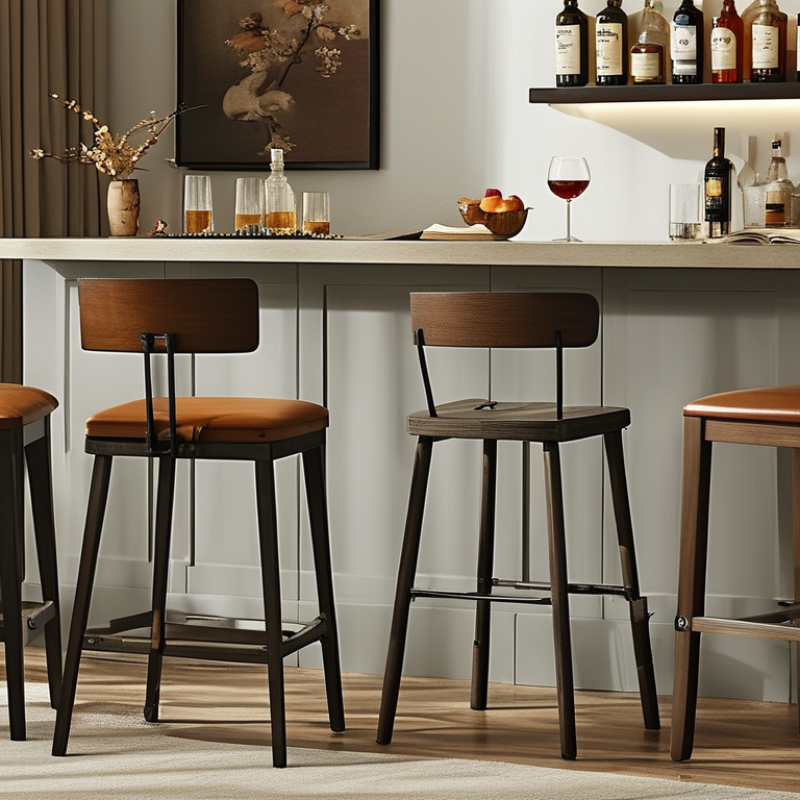
A standard bar stool height is defined by the distance from the floor to the top of the seat. For most raised bars, the seat measures 28 to 32 inches high. This range usually fits a bar surface measuring 40 to 42 inches. The gap leaves enough room for knees, plates, and relaxed movement.
Counter stools are lower. Their seats generally stand 24 to 27 inches high for counters around 36 inches tall. Measure your surface before ordering. Then subtract about 9 to 12 inches for comfortable legroom.
This simple check prevents the common mistake of choosing a stool by appearance alone. A footrest also matters, especially when the seat is tall.
In production inspections, I check seat height at several points because soft cushions can compress differently. A stool listed as 30 inches may feel closer to 29 inches after use. That small difference can affect posture. This rule is not perfect. Taller users may prefer extra height, while children or compact kitchens may need less. I once selected a stool that matched the measurements but felt awkward because its footrest sat too low. Seat height is only one part of comfort; apron thickness, cushion firmness, and back support also deserve careful review.
For a standard kitchen counter, 860 to 920 millimeters high, choose a stool with a 610 to 660 millimeter seat. This leaves comfortable legroom, usually about 250 to 300 millimeters.
For a raised bar or pub table, the surface often measures 1,020 to 1,070 millimeters. A suitable bar stool normally has a 710 to 760 millimeter seat. The difference may look small on paper. Your knees will notice it quickly.
For dining tables near 710 to 760 millimeters high, use chairs or low stools around 430 to 480 millimeters high. Taller seats can make meals uncomfortable.
In my experience reviewing furniture dimensions, seat height alone is not enough. A thick cushion may compress during use, while a fixed footrest can change how the stool feels. Check the seat width, frame stability, and clearance beneath the table. Swivel functions also need space. There is no perfect size. Even careful measurements can feel wrong after long use. A sample stool, tested at home for several minutes, often reveals more than a specification sheet. Manufacturers in China may list dimensions in millimeters, but product tolerances can still vary slightly. Ask for the finished seat height before ordering.
Choosing the right bar stool height begins with the dining surface, not the stool’s appearance. The National Kitchen & Bath Association’s planning guidelines place standard countertops near 36 inches high. They place bar surfaces near 42 inches. For a comfortable fit, choose a 24–26-inch seat for a counter and a 28–30-inch seat for a bar.
Leave about 9–12 inches between the seat and tabletop. This space allows knees to move naturally and supports relaxed dining. The 2024 Houzz U.S. Kitchen Trends Study shows that kitchen islands remain a major renovation focus, making accurate island seating measurements increasingly important. A 36-inch island with a 30-inch stool can feel cramped. I have seen this mistake in showroom layouts. The seat looked attractive, yet guests touched the underside with their knees.
Dining tables usually stand around 28–30 inches high, so they need 17–19-inch dining chairs instead. Counter stools suit 34–36-inch surfaces. Bar stools suit 40–42-inch surfaces. Measure the finished floor to the top of the surface, including stone or tile. Small errors matter. Thick cushions also compress over time, changing the practical height. For China-made stools, confirm seat height, footrest position, and the actual finished dimensions before ordering. A perfect rule does not exist. Your body, tabletop edge, and daily sitting habits still need testing.
Chinese bar stools stand out through practical materials and adaptable design. Bamboo offers a light, warm appearance and grows quickly, while rubberwood provides a stable, smooth surface for painted finishes. Metal frames add strength, especially when powder-coated against kitchen moisture. Woven rattan brings texture, but it needs careful sealing and gentle cleaning. Grand View Research valued the global furniture market at about USD 516.7 billion in 2022, showing strong demand for varied materials and flexible home products.
Design details matter more than decoration alone. Many Chinese manufacturers combine curved plywood seats with steel legs, reducing visual weight and shipping volume. Swivel bases improve movement, while footrests support the legs during longer meals. For a 40–42-inch counter, a 28–30-inch seat usually feels suitable. A 24–26-inch seat often fits standard counters better. ANSI/BIFMA seating tests assess durability, stability, and structural performance. Buyers should request comparable test records, not vague strength claims. A beautiful stool can still wobble.
Tips: Check welds, corner joints, seat edges, and the footrest before ordering. Ask about moisture resistance and replacement parts. Rattan may look excellent in photos, but uneven weaving can appear after use. I once underestimated this detail. The finish looked refined, yet the sharp underside needed sanding. Small flaws matter. They affect comfort, safety, and long-term trust.
| Data Dimension | Standard or Typical Specification | Recommended Use | Materials and Design Features | Practical Selection Notes |
|---|---|---|---|---|
| Counter Stool Seat Height | 24–26 in (61–66 cm) | Kitchen islands, breakfast counters, and worktops approximately 34–36 in (86–91 cm) high. | Common designs include molded plastic, painted steel, solid wood, plywood, and upholstered seats. | Allow approximately 9–12 in (23–30 cm) between the seat and the underside of the counter for comfortable legroom. |
| Bar Stool Seat Height | 28–30 in (71–76 cm) | Raised bars and commercial bar counters approximately 40–42 in (102–107 cm) high. | Often combined with powder-coated steel frames, solid wood legs, metal footrests, leather-look upholstery, or woven seats. | Check the actual counter height before ordering; a standard bar stool is usually too high for a kitchen counter. |
| Extra-Tall Stool Seat Height | 32–36 in (81–91 cm) | Very high counters, display counters, and selected hospitality applications. | Typically uses reinforced metal frames, foot rings, durable molded seats, or commercial-grade upholstery. | Extra-tall stools require a matching counter and should be tested for stability and foot support. |
| Adjustable Stool Range | Approximately 22–32 in (56–81 cm) | Flexible home, office, café, and multipurpose interiors. | Usually features a gas-lift mechanism, swivel seat, steel pedestal, and PU, vinyl, fabric, or molded seat shell. | Confirm the minimum and maximum seat heights, lift capacity, base diameter, and mechanism durability. |
| Seat Width | 15–18 in (38–46 cm) | Suitable for most single-seat layouts. | Square, round, saddle-shaped, and contoured seats are widely used. | For comfortable spacing, allow approximately 24–30 in (61–76 cm) of counter length per stool. |
| Seat Depth | 14–17 in (36–43 cm) | Supports everyday dining and casual seating. | Curved plywood, molded polypropylene, padded foam, and upholstered cushions can improve comfort. | A deeper seat may feel more comfortable but can reduce clearance in narrow kitchens or compact cafés. |
| Frame Material: Steel | Tubular or solid steel frame | Homes, restaurants, cafés, bars, and high-use commercial environments. | Powder coating provides a broad range of colors and improves resistance to everyday abrasion and corrosion. | Look for smooth welds, even coating, non-slip feet, and a stable base design. |
| Frame Material: Aluminum | Lightweight metal construction | Outdoor seating, patios, terraces, and spaces requiring frequent movement. | Aluminum is naturally corrosion-resistant and can be paired with synthetic wicker, plastic, wood, or upholstered seats. | Verify outdoor suitability, drainage, UV resistance, and resistance to strong coastal exposure. |
| Frame Material: Solid Wood | Common species include rubberwood, beech, ash, and oak | Residential kitchens, dining areas, cafés, and hospitality interiors requiring a warm appearance. | Wood frames may feature visible grain, turned legs, angled supports, mortise-and-tenon joints, or stained finishes. | Confirm moisture protection, joint construction, finish durability, and whether the wood is kiln-dried. |
| Seat Material: Plywood or Wood | Finished, painted, or veneered surface | Modern, Scandinavian, industrial, and traditional interiors. | Provides a firm seat, visible grain, curved plywood forms, and a relatively simple maintenance profile. | Edges should be smooth and sealed, especially for commercial or high-humidity applications. |
| Seat Material: Polypropylene or Plastic | Molded one-piece or shell construction | Contemporary homes, cafés, food-service areas, and some outdoor applications. | Lightweight, easy to clean, and available in many colors; reinforced ribs can improve structural stiffness. | For outdoor use, verify UV-stabilized material and the manufacturer’s temperature and load guidance. |
| Seat Material: Upholstery | Foam cushion with fabric, PU, vinyl, or leather covering | Dining areas, lounges, restaurants, hotels, and premium residential settings. | Offers greater softness and design flexibility, with options for piping, channel stitching, quilting, and contrasting colors. | Commercial settings benefit from abrasion-resistant, stain-resistant, and easy-clean coverings. |
| Backrest Design | Backless, low-back, mid-back, or full-back | Backless stools suit compact spaces; backed stools are better for longer periods of sitting. | Chinese manufacturing commonly combines curved back shells, metal supports, wood frames, and padded upholstery. | A backrest improves support but requires more clearance and may make stools harder to store beneath a counter. |
| Footrest Design | Integrated front rail, wraparound ring, or continuous foot bar | Recommended for stools with seat heights above approximately 24 in (61 cm). | Steel or aluminum footrests may be welded, bolted, chrome-finished, or powder-coated. | The footrest should feel stable, have smooth edges, and support a natural lower-leg position. |
| Swivel Function | Fixed, 180-degree return swivel, or 360-degree swivel | Useful in kitchens, bars, lounges, reception areas, and flexible commercial layouts. | Common mechanisms include steel swivel plates, return-memory systems, and gas-lift bases. | Check rotation smoothness, return alignment, noise level, and long-term load performance. |
| Stackable Design | Usually 2–6 stools per stack, depending on structure | Cafés, event spaces, restaurants, classrooms, and storage-sensitive interiors. | Typically uses lightweight steel, aluminum, polypropylene, or nesting wood frames. | Confirm stack height, anti-scratch protection, lifting weight, and stability when stacked. |
| Industrial Design Characteristics | Metal frame, exposed hardware, distressed or neutral finishes | Loft apartments, cafés, restaurants, retail spaces, and modern hospitality interiors. | Common combinations include black steel, reclaimed-look wood, aged finishes, rivet details, and low-back seats. | Suitable for durable visual styling, but distressed finishes should still have smooth, safe contact surfaces. |
| Contemporary Design Characteristics | Clean lines, molded forms, mixed materials, and neutral or bold colors | Modern kitchens, offices, cafés, apartments, and commercial interiors. | Frequently combines powder-coated metal, molded plastic, curved plywood, boucle-style fabric, PU, or textured upholstery. | Choose a consistent color palette and confirm that the seat shape supports the intended duration of use. |
| Recommended Load Consideration | Follow the tested capacity stated for the specific model | Important for residential, hospitality, and public-use applications. | Reinforced joints, crossbars, wide bases, and properly engineered welds can improve stability. | Do not select solely by appearance; request test information and inspect frame, joints, feet, and mechanism quality. |
Key measurement rule: Measure from the floor to the underside of the counter, then select a stool that leaves approximately 9–12 inches (23–30 cm) of knee and leg clearance.
China Best Bar Stools: What Is the Standard Height?
Choosing the right bar stool starts with measuring, not guessing. Measure from the floor to the top of the counter or bar. Then measure the clear space beneath its edge. A comfortable stool usually leaves 9 to 12 inches between the seat and tabletop. This gap gives your knees room and prevents a cramped posture. Measure twice. Floors and counters are not always level.
For a 36-inch kitchen counter, choose a counter stool with a 24- to 26-inch seat height. A 40- to 42-inch bar usually needs a 28- to 30-inch seat. These ranges are useful, but they are not absolute. Thick countertops, apron rails, and personal leg length can change the result. I have found that a 30-inch stool feels too tall when the counter has a deep underside frame. Check the seat height from the floor to the highest sitting surface, not the backrest.
Test the stool beside the actual counter if possible. Sit with both feet supported and your elbows near the work surface. Allow about 24 inches of width per person for daily comfort. Swivel seats can improve access, while footrests reduce pressure on the legs. Adjustable models seem flexible, yet their mechanisms may reduce stability at maximum height. Upholstery can compress over time, so its listed height may feel slightly different after months of use. Consider cleaning, weight capacity, and the user’s posture before ordering.
Recommended bar stool seat heights based on common counter, bar, and high-table dimensions.
To choose the right stool, measure from the floor to the underside of the counter or tabletop. A comfortable clearance of approximately 9–12 inches between the seat and the underside of the surface is generally recommended. Seat heights shown here are typical ranges: counter stools for 34–36 inch surfaces, bar stools for 40–42 inch surfaces, and extra-tall stools for 44–48 inch surfaces.
: Standard bar stools usually have seats 28 to 32 inches high. They fit bar surfaces measuring about 40 to 42 inches. Leave 9 to 12 inches for legroom.
Counter stools usually measure 24 to 27 inches from floor to seat. They suit counters about 34 to 36 inches high. Your knees should move freely underneath.
Dining tables usually stand 28 to 30 inches high. Choose dining chairs with seats around 17 to 19 inches high. Bar stools are generally too tall.
Leave about 9 to 12 inches between the seat and tabletop. This space supports natural knee movement and comfortable dining. Too little space feels cramped.
Yes. Measure from the finished floor to the surface top. Include stone, tile, or other surface materials. Measure twice.
Yes. Soft cushions can compress during regular use. A listed 30-inch seat may feel closer to 29 inches later. That small change can affect posture.
Yes. A footrest supports your legs on taller stools. Its height should feel natural when your feet rest lightly. A low footrest can make a correctly sized stool feel awkward.
No. Check apron thickness, cushion firmness, back support, and footrest placement. A stool may match the measurements yet still feel uncomfortable. I once overlooked the footrest.
Yes. Taller users may prefer extra height. Children or compact kitchens may need lower seating. Test one stool before ordering several.
Choosing the right seating starts with understanding what is the standard height of a bar stool. In general, bar stools are designed to match elevated counters, bars, or tall dining tables, but the ideal size depends on the surface height and the amount of legroom required. Counter-height stools, bar-height stools, and extra-tall models each serve different purposes, so measuring from the floor to the underside of the counter is an important first step. A comfortable gap between the seat and tabletop allows people to sit, eat, and move easily.
Chinese bar stools are available in a wide range of heights, materials, and styles to suit modern, industrial, minimalist, and traditional interiors. Options may include wood, metal, leather, fabric, or mixed materials, with features such as backrests, footrests, swivel seats, and adjustable mechanisms. By comparing stool height with the dining surface and considering room layout, comfort, durability, and visual style, buyers can select seating that is both practical and attractive.
Hark Homes